
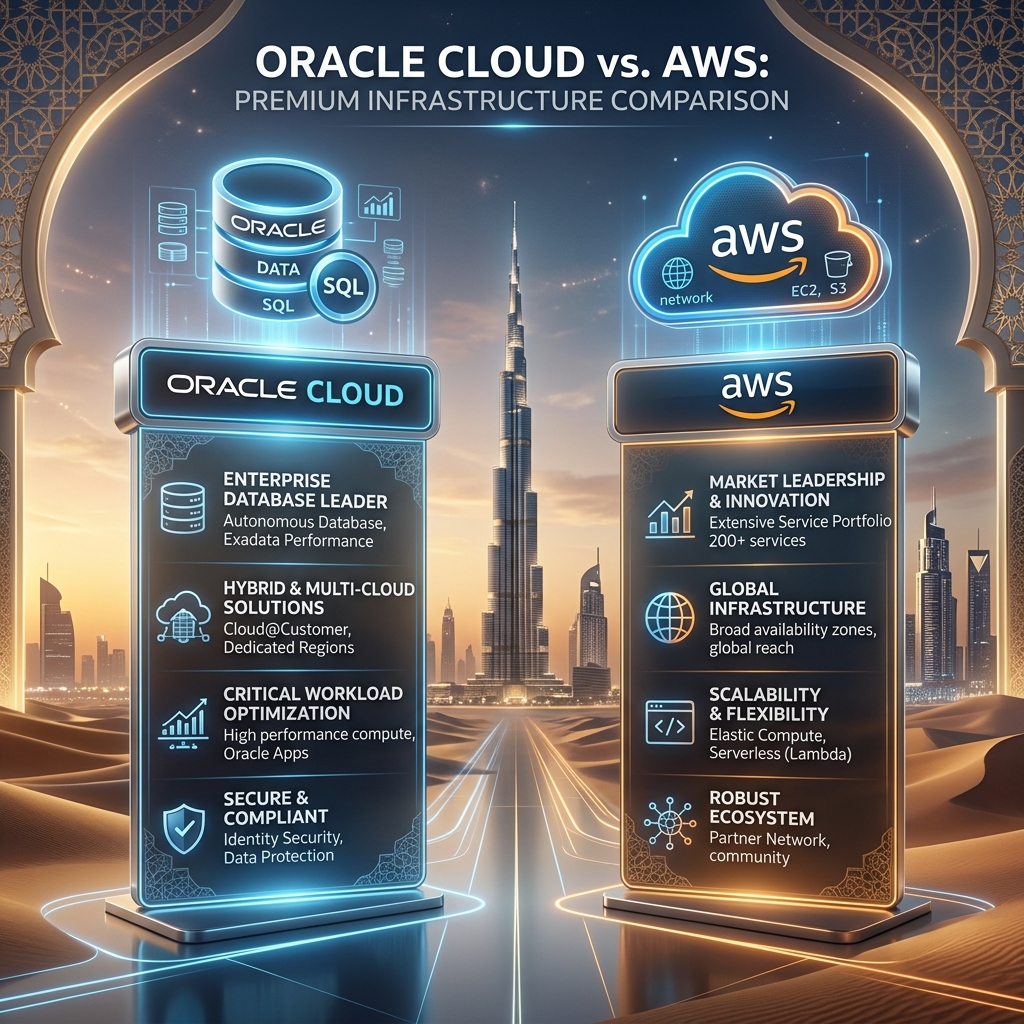
The Cloud War in the Middle East
The Gulf region, led by the UAE's digital ambitions and Saudi Arabia's Vision 2030, has become one of the most dynamic cloud markets globally. Businesses from Dubai to Riyadh are moving away from traditional data centers to agile cloud environments. While AWS has long been the global leader, Oracle Cloud Infrastructure (OCI) has made significant inroads, particularly in the enterprise and government sectors. If you are looking for an Oracle DBA Dubai or a cloud strategist, understanding this rivalry is essential.
Oracle Cloud (OCI): The Enterprise Database Specialist
Oracle has rebuilt its cloud from the ground up (Gen 2) with a focus on high-performance enterprise workloads, particularly those running Oracle Databases.
Key Advantages for Gulf Businesses:
- Superior Database Performance: With Autonomous Database and Exadata Cloud Service, Oracle offers unmatched performance for complex, data-heavy applications.
- Cost-Effective for Oracle Workloads: If you are already running Oracle licenses, the "Bring Your Own License" (BYOL) program on OCI is highly attractive.
- Aggressive Regional Expansion: Oracle has been very proactive in opening data regions in the UAE (Dubai, Abu Dhabi) and Saudi Arabia (Jeddah, Riyadh), which is critical for local data sovereignty laws.
AWS: The Innovation Powerhouse
AWS remains the most mature and feature-rich cloud platform, offering over 200 fully-featured services.
Key Advantages for Gulf Businesses:
- Unrivaled Breadth of Services: From AI/ML to Serverless and IoT, AWS has a tool for every possible use case.
- Massive Ecosystem: A huge library of third-party software and a vast pool of certified talent across the Gulf.
- Global Reach: While Oracle is catching up, AWS's global footprint and mature networking infrastructure are still the industry benchmark.
Head-to-Head: Database and Cost
For many Gulf enterprises, the decision boils down to the database. If your core business runs on a massive Oracle ERP or custom database, the performance gains and cost savings on OCI are hard to ignore. However, if you are building a modern, cloud-native application using microservices and a variety of data stores (NoSQL, Graph, etc.), AWS often provides a more flexible playground.
Data Sovereignty and Compliance in the GCC
Governments in the UAE, Saudi Arabia, and Qatar have strict regulations regarding where certain types of data (especially government and financial data) can be stored. Both Oracle and AWS are investing heavily in local regions to comply with these "In-Country" data requirements. Always verify the specific compliance certifications of each region before starting your migration.
The Verdict: Which is Right for You?
There is no "better" cloud—only the "right" cloud for your specific needs. Many large Gulf enterprises are now adopting a multi-cloud strategy, running their core databases on Oracle OCI while using AWS for their front-end applications and advanced AI analytics.
At L2 Global Tech, we help businesses across the Gulf navigate these complex choices, providing expert Oracle DBA services and cloud architecture guidance.
Need help deciding? Explore our Oracle Managed Services and let's talk about your cloud future.
L2 Global Tech Editorial
Enterprise Database Architects